Neutron Physics
Notes on neutron physics and reactor physics.
Chapters
- General facts about nuclear energy
- Basis of neutron physics
- Diffusion equation
- One-group/diffusion theory
- Neutron slowing down
- Resonant absorption of neutrons
- Thermalisation of neutrons
- Multigroup theory
- Poisoning by fission products
- —
- —
- Fuel evolution
- Temperature effect
- Boltzmann equation
1. General facts about nuclear energy
1.1 — History of Fermi’s pile
In 1942, Fermi and his team achieved the first controlled chain fission reaction. The neutron population increased even after the initial source was removed, showing that a self-sustaining chain reaction was occurring in the pile.
After the chain reaction generated a power of approximately 0.5 W, Fermi introduced cadmium control rods to control the reaction.
1.2 — Principle of a nuclear power plant
What mainly distinguishes a nuclear power plant from conventional plants such as coal or gas plants is the heat source.
A nuclear power plant contains a heat source that heats a working fluid to a high temperature. The fluid expands through a turbine, converting thermal energy into mechanical energy.
The turbine is connected to a generator, where mechanical energy is converted into electricity through electromagnetic induction.
After passing through the turbine, the working fluid loses energy, cools down, and is cycled back toward the heat source.
The efficiency of heat-to-mechanical-energy conversion cannot exceed the Carnot efficiency:
where is the temperature of the cold source and is the temperature of the hot source.
In a nuclear reactor, the heat source is not a combustion reaction between a fuel and oxygen. Instead, heat is produced by a controlled chain reaction involving nuclear fission.
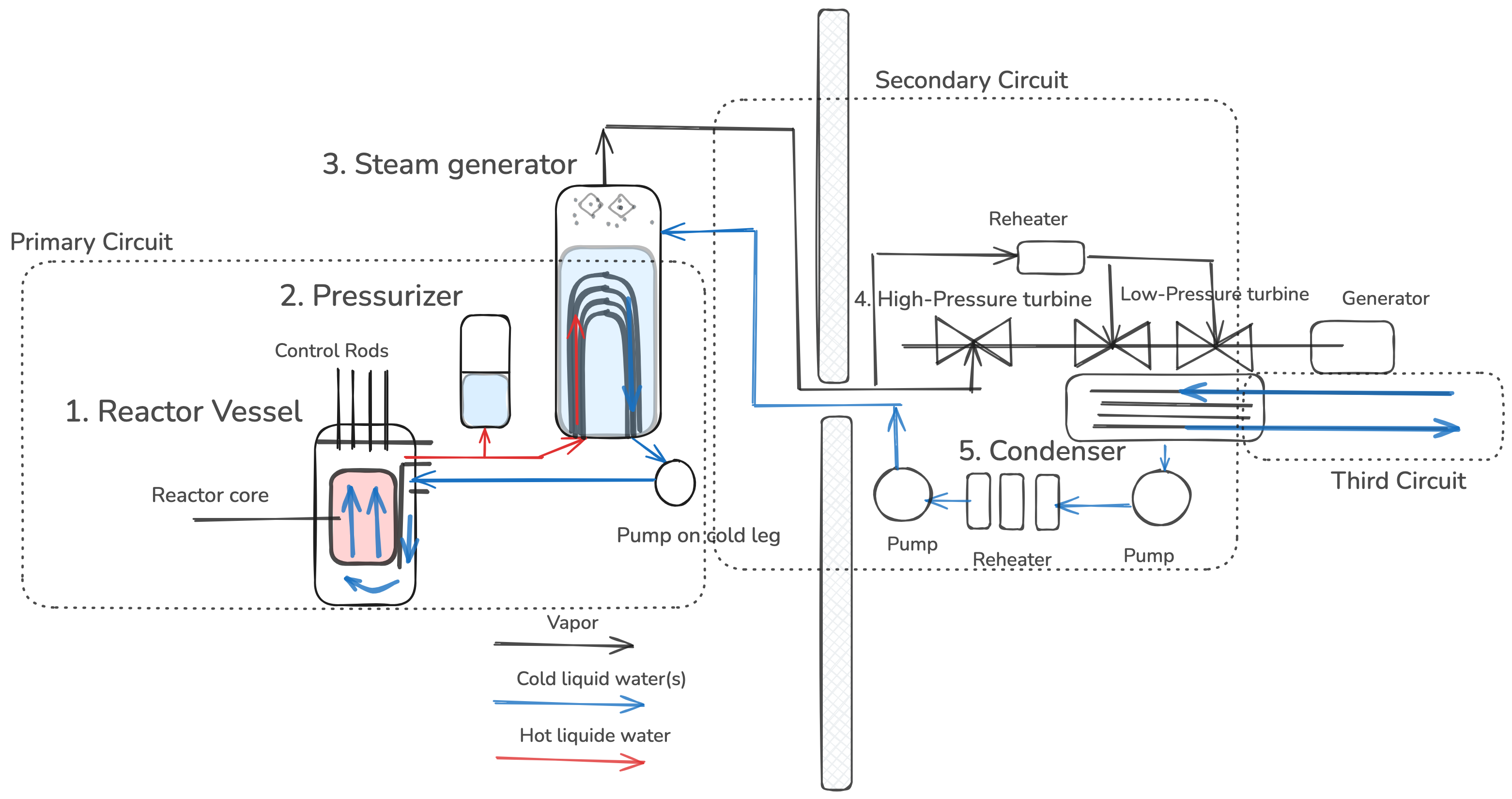
1.3 — Overview of a PWR nuclear power plant
There are different reactor types, each with its own advantages and drawbacks. In France, nuclear power plants are predominantly Pressurized Water Reactors (PWRs).
In a PWR, water is heated to approximately – while remaining liquid because of the high pressure, around bar.
The region where fission takes place is the core. Water flows through the core inside the reactor vessel, which is designed to withstand the high pressure.
The primary circuit is a closed loop. The pressure is maintained by a pressurizer, allowing the water to remain liquid despite its high temperature.
A PWR generally has three or four primary loops. Each loop contains a steam generator and a pump, while the pressurizer is connected to one of the loops.
Steam generators
Steam generators transfer heat from the primary circuit to the secondary circuit.
The primary and secondary water do not mix. Instead, heat is transferred through the steam-generator tubes.
The secondary-circuit water is heated until it becomes steam. Moisture separators remove water droplets before the steam is sent toward the turbines.
The steam drives the turbines, which are connected to the electrical generator.
After leaving the turbine, the steam is condensed and cooled in the condenser. A third circuit provides the cooling required to transform the steam back into liquid water.
The water is then sent back to the steam generator, completing the cycle.
1.4 — Fission and forces at stake in a nucleus
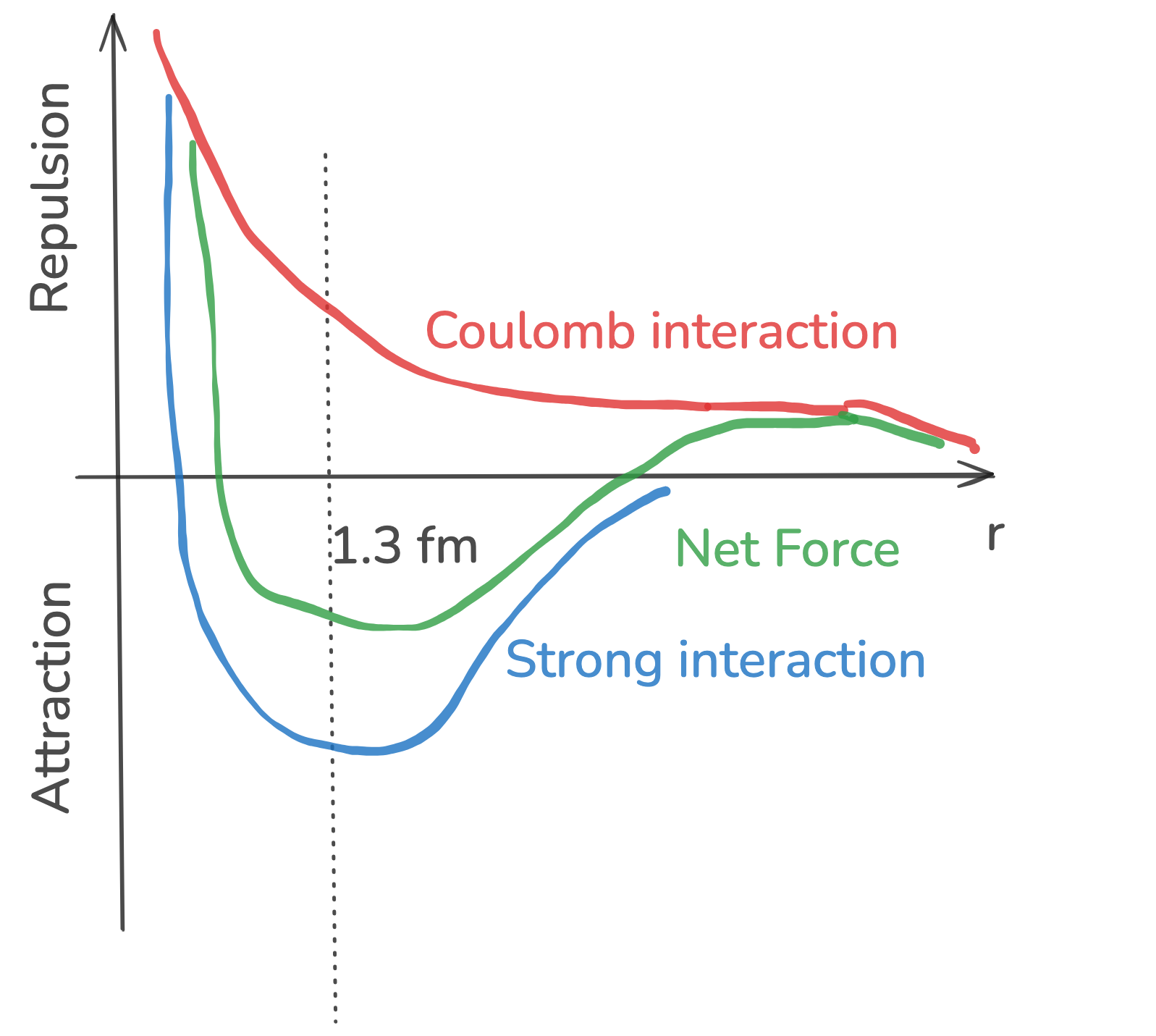
The stability of a nucleus results from a balance between Coulomb repulsion and the strong nuclear interaction.
The Coulomb interaction acts between charged particles and therefore acts primarily between protons inside the nucleus. It is a long-range interaction whose strength decreases approximately with the inverse square of the distance.
Because protons repel one another, the Coulomb interaction alone could not confine them inside such a small volume.
The strong nuclear interaction provides the attractive force necessary to bind nucleons together. It acts on both protons and neutrons and has a very short range, of approximately .
The balance between the number of protons and neutrons determines nuclear stability.
For light nuclei, the neutron-to-proton ratio is approximately . For heavier nuclei, it gradually increases toward approximately .
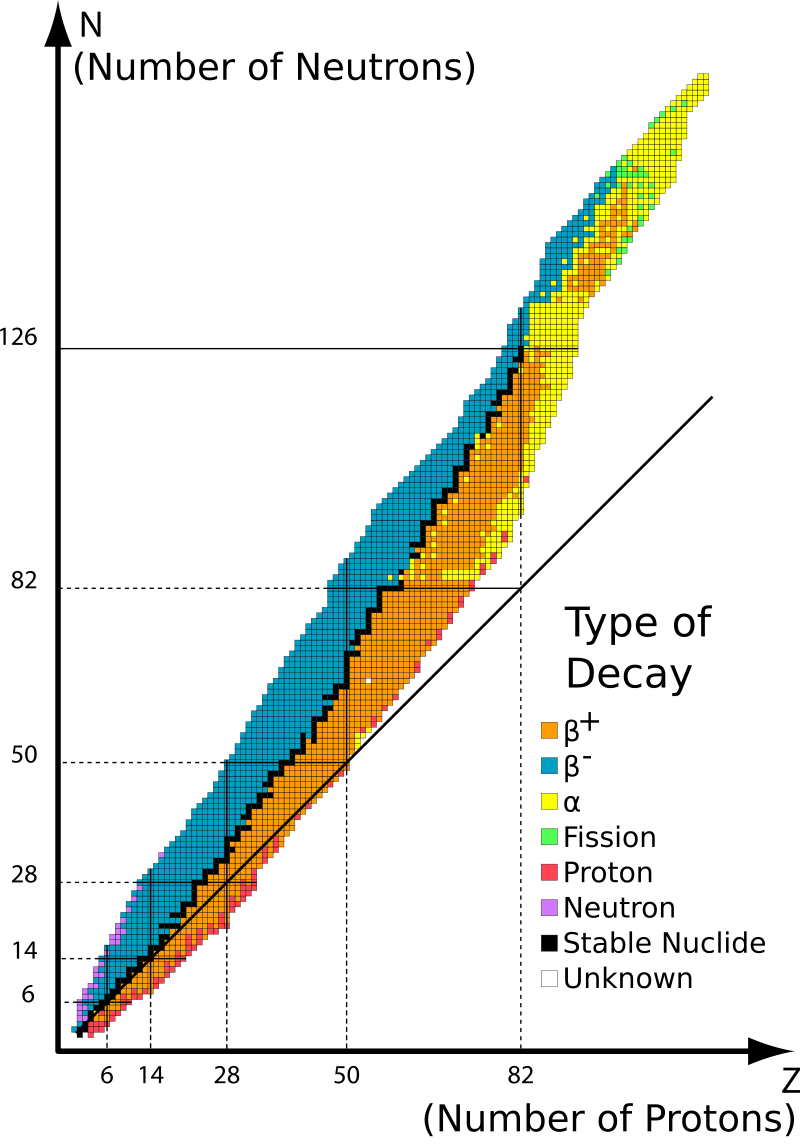
Because Coulomb repulsion increases with the number of protons, heavy nuclei are generally less strongly bound than smaller nuclei.
When a heavy nucleus undergoes fission, it splits into two smaller fragments and releases energy.
Typical nuclear fission releases around:
while chemical reactions typically involve energies of only a few eV.
1.5 — Chain reactions
A chain reaction is a process in which one reaction produces the conditions necessary for subsequent reactions.
A familiar example is combustion. A fire requires an initial energy input, after which the heat produced by combustion can trigger further combustion.
Nuclear fission works similarly. A neutron induces fission, releasing energy and additional neutrons. These neutrons can then induce further fissions.
The process can therefore continue as long as enough fissile material is available.
To control the chain reaction, we introduce the multiplication factor .
Let be the probability that a neutron causes fission, and the average number of neutrons emitted per fission:
If there are fissions at , the successive generations are approximately:
Criticality
If
the number of fissions remains constant from one generation to the next. The reactor is critical.
If
the number of fissions increases. The reactor is supercritical.
If
the number of fissions decreases. The reactor is subcritical.
1.6 — Types of reactors
For , the average number of neutrons produced per fission is approximately:
Therefore, to obtain , the probability of producing a subsequent fission needs to be roughly:
Some important facts:
- Uranium is the only naturally occurring element capable of sustaining a fission chain reaction.
- Natural uranium contains mainly and .
- generally requires a sufficiently energetic neutron to undergo fission, whereas is fissile and can undergo fission with neutrons over a broad energy range.
- Natural uranium contains approximately .
- Fission neutrons are emitted with energies of roughly .
- The fission cross section of is much higher than that of at thermal neutron energies.
This leads to two broad reactor concepts:
Fast reactors
Fast reactors use fast neutrons without significantly slowing them down.
They generally require enriched uranium or other fissile material.
Thermal reactors
Thermal reactors slow neutrons down using a moderator.
The lower neutron energy greatly increases the fission probability of , allowing reactors to operate with much lower enrichment.
1.7 — Choice of moderator
For reactors using natural or low-enriched uranium, a moderator is required to slow neutrons down to thermal energies.
An effective moderator should:
- Have a mass relatively close to that of a neutron.
- Scatter neutrons efficiently.
- Have a low neutron absorption probability.
- Be sufficiently dense to slow neutrons efficiently.
Common moderators include:
- Light water
- Heavy water
- Beryllium
- Carbon, usually in the form of graphite
Light water has a relatively high neutron absorption cross section compared with the other moderators. Therefore, reactors using light water generally require enriched uranium.
The advantage is that water is inexpensive and can simultaneously act as both moderator and coolant.
This is the principle used in PWR and BWR reactors, which represent a large fraction of operating reactors.
2. Basis of neutron physics
2.1 — Neutron-matter interaction
Neutrons are electrically neutral, so they do not interact directly with the electron cloud through the Coulomb interaction. Their interactions with matter therefore primarily involve atomic nuclei.
The probability of a particular interaction is described using a cross section .
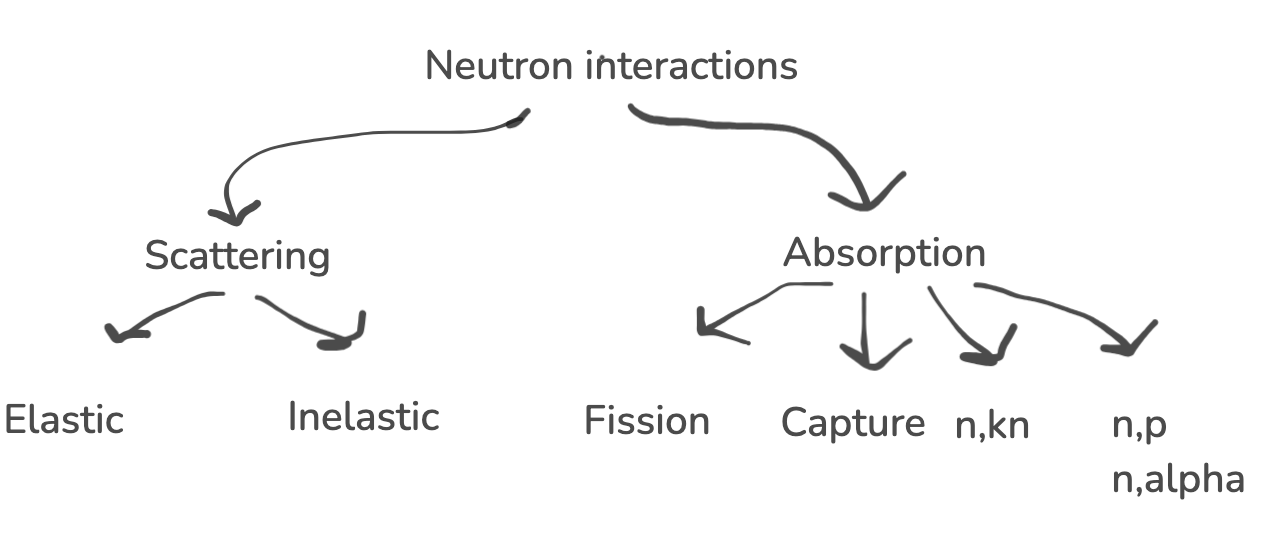
Neutron interactions can broadly be divided into scattering and absorption.
Scattering
Elastic scattering
In elastic scattering, the total kinetic energy of the neutron-nucleus system is conserved.
The neutron transfers part of its energy to the nucleus:
Inelastic scattering
In inelastic scattering, the neutron excites the nucleus and loses kinetic energy.
The excited nucleus subsequently de-excites:
This process is only possible when the incident neutron has enough energy to reach an excited nuclear state.
Absorption
During absorption, the neutron is captured by the nucleus, creating a new compound nucleus.
Several subsequent reactions are possible.
Fission
For a fissionable nucleus:
where denotes a fission fragment.
For some nuclei, fission has no effective threshold, while others require the incident neutron to provide sufficient energy.
Radiative capture
The neutron is absorbed and the resulting nucleus de-excites through gamma emission:
This is commonly referred to as an reaction.
Multiple neutron emission
This reaction has a threshold corresponding to the energy required to remove neutrons from the nucleus.
Other reactions
Examples include:
and
2.2 — Cross sections
The cross section measures the probability of an interaction between a neutron and a nucleus.
The microscopic cross section is:
The macroscopic cross section is:
with:
- : atomic density, in
- : microscopic cross section, in
- : macroscopic cross section, in
There is a different cross section for each possible type of interaction.
2.3 — Four-factor formula
describes the number of neutrons from one generation that produce fissions in the next generation.
For an infinite reactor, where neutron leakage is neglected, we introduce:
For a PWR, thermal neutrons are particularly important because they have a high probability of inducing fission in .
Starting with one thermal neutron, several factors must be considered.
Fast fission factor
Some additional fissions are caused by fast neutrons. This is represented by :
For a typical PWR:
Resonance escape probability
The probability that neutrons slow down through the epithermal region without being absorbed is represented by :
For a typical PWR:
Thermal utilization factor
Once thermalized, a neutron has a probability of being absorbed in the fuel rather than in structural materials or other components:
For a typical PWR:
Reproduction factor
Not every neutron absorbed by the fuel causes fission.
The probability that an absorption results in fission is:
Each fission produces, on average, neutrons.
Therefore:
Defining:
we obtain the four-factor formula:
2.4 — Transport equation
The transport equation describes the evolution of neutron density.
Consider a volume containing neutrons with velocity .
The time variation of the neutron population can be written as:
The streaming term describes neutrons entering or leaving the volume due to their spatial movement:
The complete transport equation accounts for all positive and negative contributions to the neutron balance, including streaming, scattering, absorption, and fission.
3. Diffusion equation
3.1 — Establishing the diffusion equation
The neutron flux is related to neutron density by:
where:
- is the neutron density
- is the neutron velocity
- is the neutron flux
The flux is expressed in:
We want to study the evolution of neutron density.
Since:
we have:
Assuming that does not change with time:
For a volume containing neutrons, we then need to account for all mechanisms that contribute positively or negatively to the neutron population.
4. One-group / diffusion theory
Further notes to be completed.
5. Neutron slowing down
Further notes to be completed.
6. Resonant absorption of neutrons
Further notes to be completed.
7. Thermalisation of neutrons
Further notes to be completed.
8. Multigroup theory
Further notes to be completed.
9. Poisoning by fission products
Further notes to be completed.
12. Fuel evolution
12.1 — Fuel management
| Fuel | Enrichment | Moderator | Coolant | Reactor |
|---|---|---|---|---|
| U (metal) | 0.72% (natural) | Graphite | CO₂ | AGR / UNGG |
| UO₂ | 0.72% (natural) | Graphite | CO₂ | HTR |
| UO₂ | 0.72% (natural) | D₂O | D₂O | CANDU |
| UO₂ | 3–4% | H₂O | H₂O | PWR |
| UO₂ | 2% | Graphite | Boiling H₂O | RBMK |
| UO₂ | 3% | H₂O | Boiling H₂O | BWR |
| U₃Si₂ | 20% | H₂O | H₂O | OSIRIS |
| U (metal) | 90% | H₂O | H₂O | ORPHÉE |
| UO₂ + PuO₂ | 15% | — | Na | SFR |
13. Temperature effect
Further notes to be completed.
14. Boltzmann equation
Further notes to be completed.