Battery and Fuel Cell Technologies
Most of the content on this page comes from the course of Didier Dalmazzonne, although I may have added other information on top.
Battery Overview
The first battery was created by Volta in 1782.
Lead-Acid Battery
Invented by Gaston Planté in 1859, the lead-acid battery represents around 80% of installed battery capacity.
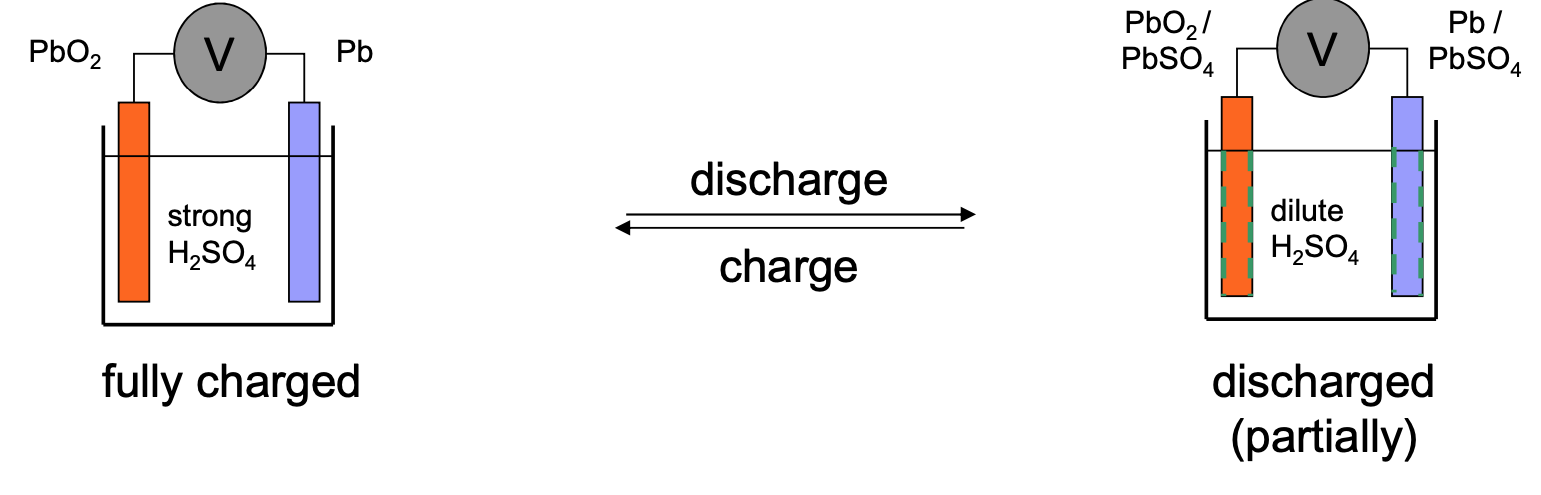
The overall reaction is:
Comparison of Battery Technologies
| Battery type | Number of cycles (100% discharge) | Cost (€/kWh) |
|---|---|---|
| Li-ion | 4000 | 500 |
| Lead-acid | 800 | 100 |
| NaS | 4500 | 450 |
| Zebra | 4500 | 450 |
| Vanadium | 20 years | 450 |
| Zn/Be | 4500 | 650 |
Lithium-Ion Technologies
| Battery type | Cathode | Anode | Cell voltage | Cost | Energy density | Cycle life | Discharge rate |
|---|---|---|---|---|---|---|---|
| LCO | Li Co Oxide | Graphite | 3.6 V | Medium | 500 Wh/L | Short | Up to 3C |
| LFP | Li Fe Phosphate | Graphite | 3.2 V | Low | 180 Wh/L | Medium | Up to 25C |
| Li-NCA | Li Ni Co Alumine | Graphite | 3.6 V | Low | 500 Wh/L | Short | Up to 3C |
| Li-NMC | Li Ni Mn Co | Graphite | 3.7 V | Medium | 500 Wh/L | Medium | Up to 3C |
| LTO | Ni Co Alumine | Li Ti Oxide | 2.4 V | High | 120 Wh/L | Long | Up to 10C |
Hydrogen Overview
Hydrogen Today
Data
- World production: 75 Mt
- Energy equivalent of H₂ production: 0.2 Gtoe/year
- Oil production: 4.4 Gt/year
- World primary energy consumption: 14.5 Gtoe/year
- Hydrogen produced by fossil-fuel reforming: 95%
- Fossil-fuel reforming and gasification: 1 GtCO₂/year
- Human CO₂ emissions: 35–40 GtCO₂/year
Main Current Uses of H₂
- Oil refining: 44%
- Ammonia for fertilizers: 38%
- Food industry: 9%
- Methanol and chemicals: 8%
- Space propulsion: 1%
Pros and Cons
Pros
- Raw material abundant and 100% regenerated
- High energy density per unit of mass
- Variety of sources, production methods and uses
- No direct greenhouse effect, but hydrogen interacts with other molecules which can contribute to an increase in the greenhouse effect
Cons
- Cost
- Low density per unit of volume (40 kg/m³ compared with approximately 800 kg/m³ for oil)
- Difficult to store
- Lack of dedicated infrastructure and distribution networks
- Risk acceptance
Converting Hydrogen to Energy
There are two main ways of converting hydrogen into energy:
- Direct combustion
- Fuel cells
Main Hydrogen Fuel Cell Technologies
| Type | Electrolyte | Temperature (°C) | Fuel | Efficiency | Power | Maturity |
|---|---|---|---|---|---|---|
| Alkaline | KOH | 50–200 | Industrial H₂ | 65% | 10–100 kW | Mature |
| Phosphoric Acid | H₃PO₄ | 180–220 | H₂ | 35–40% | 10 MW | Commercial |
| Proton Exchange Membrane | Solid polymer | 30–100 | H₂ | 35–40% | 100 W–500 kW | Commercial |
| Molten Carbonate | Li₂CO₃, K₂CO₃, Na₂CO₃ | 600–700 | H₂ | 50–60% | 100 MW | Development |
| Solid Oxide | ZrO₂, Y₂O₃ | 800–1050 | H₂, CO₂, CH₄ | 50–65% | 100 MW | Development |
Proton Exchange Membrane
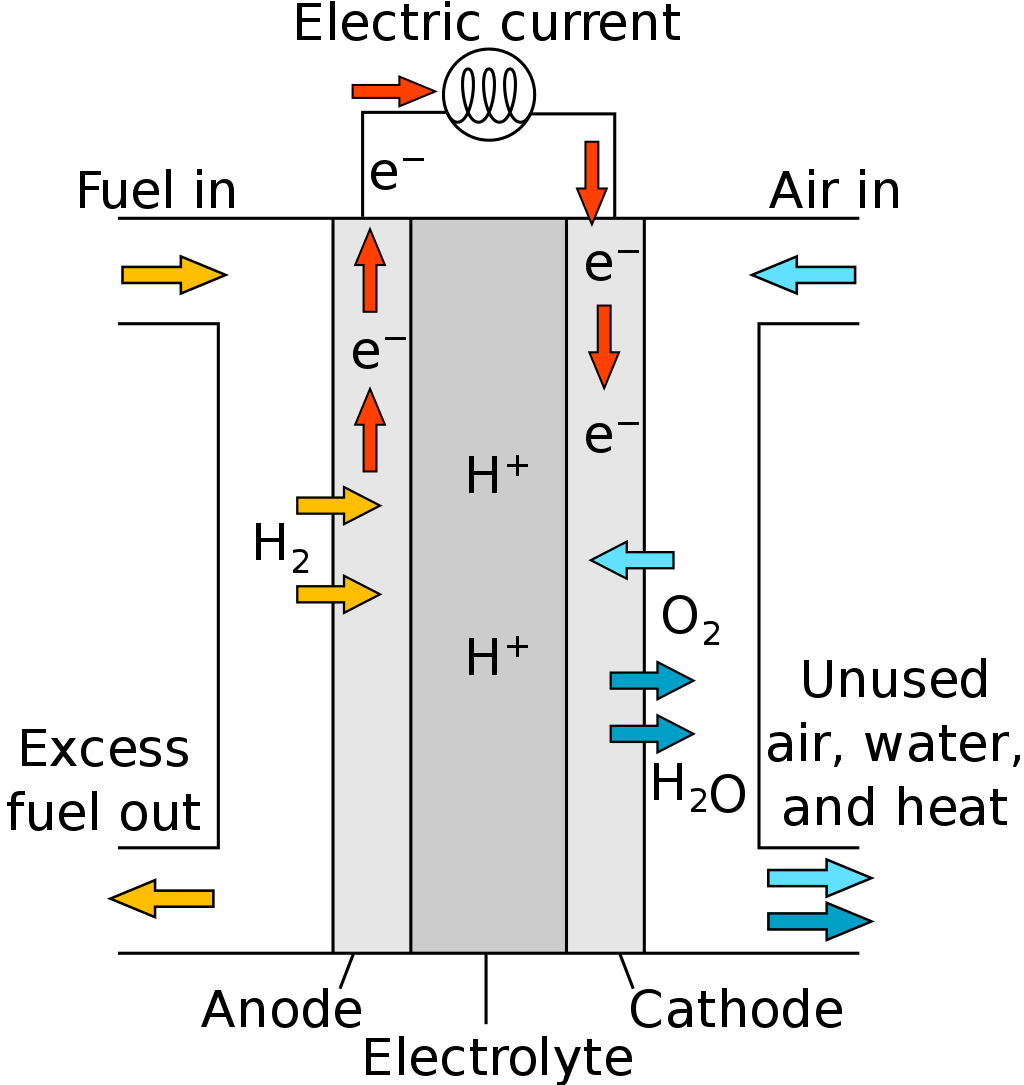
A proton exchange membrane (PEM) is a semipermeable membrane designed to allow protons to pass through while blocking reactants such as H₂ and O₂.
It can be used in a fuel cell according to the following reaction:
Perspectives for Hydrogen
Hydrogen production would need to be multiplied by approximately 12 to meet 20% of today’s energy requirements.
Hydrogen Production Costs
According to DOE data from 2013:
- Large-scale SMR: 1.5 $/kg
- Small-scale SMR: 3–6 $/kg
- Electrolysis: 6–15 $/kg
- Carriage costs: 1.25 $/kg
- Global hydrogen costs: 22–135 $/GJ
- Global oil costs: 7 $/GJ
Conclusion
Hydrogen is regarded as a solution for long-term storage of energy produced from low-carbon sources.